Crawl space water and mold in Raleigh
Water in a Raleigh crawl space comes from three places: a leaking supply or drain line, rain running toward the foundation, or groundwater rising after days of storms. Find the source, pump out what is standing, then dry the soil, joists and subfloor with dehumidifiers. If the water is sewage, treat it as contaminated and keep out.
The call is connected with an independent local company. Water category here: category 2 (gray) unless the source is known to be clean or is sewage.
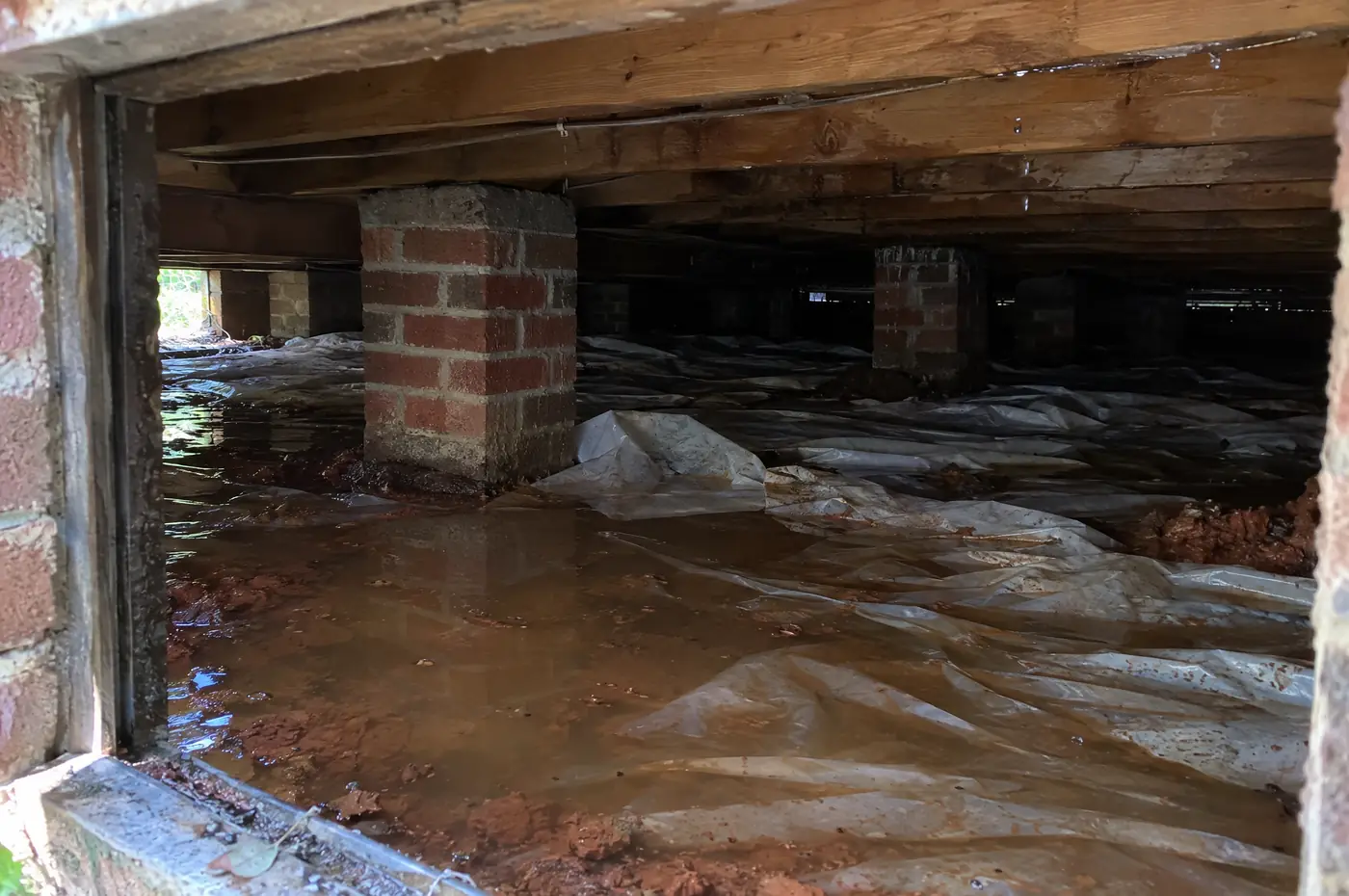
Illustrative photo.
A broken line between the street and the house is the owner's repair under the City of Raleigh's water rules; a break in the main under the street goes to Raleigh Water at 919-996-3245, any hour. Water that shows up after every heavy rain is usually grading, gutters or groundwater, which a plumber cannot fix.
Right now
- 1Do not crawl into standing water if wiring, a furnace or a water heater sits in it. Turn off the breaker for the crawl space from a dry spot, or wait for help.
- 2Look for the source with a flashlight from the door: a spraying line, a dripping drain, or water entering at one wall.
- 3If a pipe is leaking, close the main valve. In a house on a crawl space it is often near where the water line comes through the foundation.
- 4Keep children and pets out, and keep the access door closed if the water smells of sewage.
- 5Take photos of the water level against a pier or a joist so you can show how deep it was.
Raleigh facts for this problem
Raleigh Water is responsible for breaks in water and sewer mains in the street; the property owner is responsible for breaks on private property.
Source: City of Raleigh: Water Service FAQ.
Raleigh Water takes reports of main breaks and leaks at 919-996-3245, 24 hours a day, seven days a week.
Source: City of Raleigh: Water Service FAQ.
In the Raleigh record, a day with 1.64 in. of rain or more is in the wettest 1% of days; 114 of those days have come since January 1, 2000.
Source: ACIS daily record, Raleigh Area record (ACIS), today the Raleigh-Durham International Airport station, calculated by Raleigh Water Damage NC on November 13, 2026.
September is Raleigh's wettest month by the 1991-2020 normals, at 5.15 in.
Source: NCEI 1991-2020 normals via ACIS, Raleigh Area record.
Homeowners policies do not cover flood or rising water, according to the NC Department of Insurance.
Source: NC Department of Insurance: FAQs About Homeowners Insurance.
NC State Extension says there is no federal or state certification program for mold remediation, so a crew working on moldy joists has no state mold license to show.
If water under the house is coming from a broken pipe between the street and the house, Raleigh Water says breaks on private property are the owner's to fix; a break in the street main is the city's, at 919-996-3245 any hour. Water that pools after every heavy rain is usually grading or groundwater, not plumbing.
Sources: City of Raleigh: Water Service FAQ
See how much rain fell at the airport this week, or open the water damage estimator with this problem filled in.
What the work usually looks like, day by day
Use it to follow along when a company walks you through the job. Every house is different.
- First visit1. Find the sourceThe crew checks supply lines, drain lines and the foundation walls, and asks when the water appears, to tell a plumbing leak from rain or groundwater.
- First visit2. Pump out and pull wet plasticStanding water is pumped out. A torn or soaked vapor barrier and fallen insulation usually come out in bags.
- Days 1 to 43. Dry the woodDehumidifiers and air movers run under the house until the joists and subfloor read dry. Readings are logged each visit.
- If mold is found4. Clean the framingMoldy insulation is removed and joists are cleaned. With no state mold license in North Carolina, ask what written standard the crew follows.
- Last day5. Close it upNew vapor barrier and insulation go back once the wood is dry. Fixing grading or gutters is a separate job.
North Carolina's rule on mold work
North Carolina has no state license or certification for mold remediation: NC State Extension says no federal or state certification program exists for companies or people who do it. A general contractor still needs a state license from the NC Licensing Board for General Contractors when a project is valued at $40,000 or more, so ask for that number on large jobs.
Sources: NC State Extension: Mold Remediation Professionals; NCLBGC license search. More in the contractor and mold license guide.
How insurance usually treats it
Water from a sudden pipe break is treated differently from water that seeps in over time or rises from the ground. Groundwater and surface water are flood, which the NC Department of Insurance says homeowners policies do not cover. Your policy's water damage and exclusions sections decide which one applies, so read them or ask your agent before work starts.
General information, not insurance advice; your policy decides. North Carolina's claim rules are in water damage insurance in North Carolina.
What changes the size of the job
- How deep the water is and how much of the crawl space it covers
- Whether the source is a pipe, rain runoff or groundwater
- Which insulation and how much of the vapor barrier must be removed
- Whether there is mold on the joists or subfloor
- How low and tight the crawl space is to work in
Prices are not quoted here: the company that comes out measures the moisture, then writes an itemized estimate.
Questions Raleigh homeowners ask
Who do I call for water in my crawl space in Raleigh?
It depends on the source. A break in the water main in the street goes to Raleigh Water at 919-996-3245. A leak on your side of the property line needs a licensed plumber to fix the pipe. Standing water and wet framing need a water damage company to pump out and dry, which is what this line connects you with.
Why is there water in my crawl space after heavy rain?
Usually because rain is running toward the house, from short downspouts, a yard that slopes the wrong way, or a high water table after days of storms. Pumping and drying deals with the water that is there; gutters, grading or a drain deal with the cause.
Is a wet vapor barrier a problem?
A few drops of condensation on the plastic can come and go in humid weather. Puddles sitting on it, a torn barrier, or a musty smell in the rooms above mean water is getting in and should be found and dried.
Can mold in the crawl space affect the house?
The EPA advises keeping indoor humidity under 60 percent and drying wet materials within 24 to 48 hours. Damp air under the floor can carry a musty smell into the rooms above, so dry the crawl space and fix the water source together.